October 30, 2011

Almost, Almost, Almost There

If I climbed this hill every week, would I get stronger? Faster? Both?

For reasons I can't explain, a Cake song started playing on my internal soundtrack—with a twist on the lyrics.
You're almost there
You're almost, almost, almost there.
There was the top of Hicks Road. I completed the climb without stopping, despite pulling my front wheel off the pavement an alarming number of times. Despite having already climbed 1500 feet before heading up the steep grade.

Having come that far, it would be silly not to continue up Mt. Umunhum Road. How else would you get to that climb? Steep in its own right, it seems easier given that one side or the other of Hicks is always the prelude.

The road passes through the Sierra Azul Open Space Preserve. While biding my time at a re-group with my fellow cyclists, my curiosity was piqued by an official sign featuring the green imprint of a distinctive seven-pointed leaf. In addition to the usual warnings about mountain lions, rattlesnakes, and poison oak, here was a warning for hikers to stay on the trails lest they stumble across an illicit marijuana farm. [There was an early-morning shootout up here in 2005, which did not end well for one of the bad guys.]

I declared victory at the gate, not feeling a need to grind further up the hill to the white-line-that-shall-not-be-crossed. I was not worried about the bad guys; like the mountain lions, I expect they are reclusive and nocturnal. I had simply had enough climbing. At the end of the day, 27 miles, 3,630 feet of elevation gain.

October 27, 2011

Elevator Profile

The shadows grow longer, the weekends grow busier, and the cyclist grows weaker and wider. Opportunities for a round-trip bike commute in (mostly) daylight are vanishing.

It was, shall we say, a bracing start to the day. With the temperature hovering just below 42F, I should have donned warmer gloves. The cold air stung my legs and face. Still, my count of fellow cyclists was typical (more than 30). Notable was a guy wearing perfectly-polished, tasseled loafers and cream-colored pants (with a reflective band on the right leg, to keep it clear of the chain).

Making good time, I included a short gratuitous hill on both trips. My quickest elevation gain was assisted, though. To reach my office on an upper floor, I carpooled. Two people, two bicycles, one elevator car.

Lost in thought on the way home, I heard the clatter of hooves before I saw the deer. Three of them scampered across the road before pausing to study me from a safe distance, uphill. Not much of a threat, this creature, moving so slowly and breathing so hard.

For the day, 39 miles and about 1000 feet of climbing.

October 15, 2011

Are You Slower Than a Seventh Grader?

Photo by Josh Hadley
[Yes.]

Slower than a guy on a mountain bike toting his daughter in a plastic seat mounted behind the handlebar?
[Yes.]

Slower than a guy on a road bike towing his daughter in a Burley trailer?
[Yes.]

In a show of mercy for our selfless Low-Key volunteer crew, the slower riders were ushered to the front of the pack. The announcement went something like this:
Juniors to the front.
And anyone else who thinks they're slower than a 12-year old.
To minimize congestion on the road, we were dispatched in smaller groups at somewhat irregular intervals.

The fastest guys were next; I was about one mile up the road when they sped past. Much of the rest of the field would pass me too, affording more of a sense of participation than I normally get [trailing off the back].

Truth be told, my usual forays up Page Mill Road involve rather wider tires and an enviable level of horsepower. This would be only my third ascent on a bicycle, and my first timed climb. That it would take more than an hour, I had no doubt.

Along the way, my spirits were lifted by so many passing climbers who encouraged me. It's one thing to cheer me along when they are descending, having already finished; it is a true gift to spare even a single word when racing up a hill. This is the essence of a Low-Key Hillclimb, and why I keep coming back for more.

A red Pantera with an out-of-state plate was extremely patient. Without a clear sight line, he hung well behind me on a grueling stretch. As soon as it was safe, I signaled him to pass. Given that there were some 140 cyclists on the road, I imagine he regretted his decision to drive up Page Mill this morning.

A dropped chain at mile 3.5 cost me close to a minute. Nonetheless, I was quite pleased with my finishing time. I ascended 2,035 feet over 8.3 miles, finishing in a tad over 69 minutes. My heart rate averaged 171 beats per minute, peaking at 180 bpm. Evidently I am unwilling to flog myself as hard as I did two years ago.

I know I can do better. The series isn't over yet.

October 8, 2011

Stress Test

Last year, I was a dedicated volunteer for the Low-Key Hillclimb series, having had the good sense to sit out. Consequently, it has been almost two years since I last pushed myself to the limit; once-vivid memories of intense suffering have dissipated.

Sierra Road. It was time. Time to reacquaint myself with the pain. What début could be more fitting for my Giro d'Italia Maglia Bianca?

I admire runners who can perform at the limit. Maybe, if my life were at stake, I could run that hard. Otherwise, my brain would intervene: This is too hard. Stop. Now. On a bicycle, I must keep moving to stay balanced on two wheels. If I stop on a steep hill, I might not be able to start up again.

Racing up a hill has taught me many things: I can push myself much harder than I had ever imagined. The same hill will be a joy to climb every time I approach it at a recreational pace. And, it is worth having a go at it, even if I will be the last rider to cross the finish line.

Technically, I was not last. One of the able-bodied young men in the field flatted, which put him about ten minutes behind me. I take my victories where I find them: today, I caught and passed a guy in an orange jersey. Evidently he was a ride-along (not registered). Just the same, I dropped him, fair and square.

What is this suffering of which I speak? Panting and sweating for a solid 48 minutes and 10 seconds. Sustaining an average heart rate of 174 beats per minute during that time (peak, 179 bpm). Burning Calories at the rate of 569 per hour. All of that to travel a mere 3.6 miles. Oh, and climb 1,815 feet. [Roughly 500 feet per mile, for the math-impaired.]

If you haven't tried something like this, believe me—you don't know what you're missing.

October 2, 2011

Apple Cider Time

I am beginning to wonder if every ascent of Highway 9 will be memorable.

Late on this Sunday morning, I was passed by a posse of sporty Nissans and a souped-up Miata (bedecked with a truly hideous spoiler). The speed limit is 30 mph and they were behaving nicely ... paced by a pickup truck, as it were.

Evidently they did not behave so nicely once they took the lead.

There are some lovely curves on the way from Saratoga to Skyline, including an enticing pair of 180-degree hairpins. The final hairpin, however, is a bit different. It is sharp and short and marked with a sign that recommends a speed of 20 mph.

When I rounded that bend, the posse was lined up on the opposite side of the road, facing downhill. [Odd.] Six or more young men were standing alongside one car, off the road with its hood up.
Why did the Nissan cross the road?
The punchline would be supplied by the cyclists I met at the top. They heard the screeching tires. They saw the car off the road, in the dirt, after it spun out. Fortuitously, no one was in the reckless driver's path.

We continued along Skyline to attend to some pressing business.

Club members and friends pitch in each fall: apples are picked, washed, trimmed and quartered, crushed, and pressed into fresh cider. With picking and washing well-tended, I tried my hand at the remaining tasks. [With the exception of the pressing, upper-body-weakling that I am.]

That watery stuff you can buy in cartons each fall? Bah! Nothing like the real thing. Not even close.

October 1, 2011

I Will Remember You

I will remember your goofy faces, your sharp wit and exquisite puns, the ease with which you would ride alongside us and snap photos—no hands on the bars. I will remember the joy of shadowing you down a curvy, unfamiliar road at speed, without a care, knowing that you would alert me to any oncoming traffic.

I remember when you flatted on one of the earliest rides I led for the club. You were the president, and a far more experienced rider than I was; I doubled back to stay with you. Never leave a rider behind. You were struggling to add another patch to your tube, on top of what appeared to be a stack of patches. [I did not laugh.] When I offered you a spare tube, you revealed that you had one. [I did not laugh.]

There are so many dimensions to a life. Today, those united in remembrance of you. Wife, sons, mother, sister, brother, college classmate, fellow fans of science fiction and gaming, former co-workers, and so many cyclists. Alternately, we laughed and cried.

We were reminded to remember the whole of your life, which was not defined by the irrevocable choice you made in a dark night of the soul.

Paul, I will remember your friendship.

In desperation, never abandon hope. Seek help. 1-800-273-8255

September 24, 2011

Conversation Piece

Climbing Old La Honda Road this morning, I heard the quick "yip" of a siren. On Old La Honda? That made no sense. Maybe one of the homeowners has an unusual alarm system.

I rounded a bend and was completely astonished to see that a motorcycle officer had indeed stopped a minivan driver. Slow climber that I am, I overheard a snippet.
Do you live on this road, ma'am?
Are you late for an appointment?
The supreme irony of this encounter would be clear if you had been following the chatter on one of the local bike club mailing lists over the past week. The authorities recently stepped up enforcement for cycling infractions in this area, and there has been much indignation about (perceived) selective enforcement.

There would be more surprises on this familiar climb today.

A couple of riders passed me. [No, that's not surprising.] One called out Cima Coppi! ... in perfect Italian. My feeble monolingual brain was not quick enough to respond with a friendly Ciao! I had chosen to wear the new jersey that I had earned on the Stelvio Pass; I did not expect anyone to understand what it represented.

Never underestimate the Bay Area cycling community. A racer in a team kit slowed to chat with me, wanting to hear about the Stelvio. He had spent some time in Italy, and compared watching the Giro d'Italia to the Tour de France (the former being much less commercialized). The crowds are smaller, he explained. There is nowhere to park a car on the big climbs; to watch, you need to cycle up.

Before the day was out, another pair of guys climbing Tunitas would chat with me, too—one had also climbed the Stelvio. What a great way to meet interesting people! At my pace, wearing any other jersey, I would be lucky to elicit so much as an "on your left" from any of those riders.

Riding without full stats today; this 41-mile loop likely involved some 4000 feet of climbing. With all that conversation, the top of Old La Honda came much sooner than I expected. Surely, I am not faster.

September 10, 2011

The Long and Windy Road

Having just climbed some 27,375 feet over 287 miles during ten days in Italy, climbing 6,260 feet over 100 miles down the California coast should be no problem. Piece of cake, right?

Two days to recover from jet lag were almost enough. Almost.

An Audi R8 led us out at a brisk pace—I averaged 19.7 mph over the first 10 miles, which is a personal best. Of course, that is also not a sustainable pace for me and once the hills started rolling, I started crawling. [I must note that the R8 driver failed to rev the engine in the tunnel under Robinson Canyon Road, an offense for which the key to that vehicle should be summarily confiscated.]

The day was cool and foggy, but not as intensely so as last year. The sun began to break through near the Bixby Bridge, which was a fine place to peel off a layer. I rounded the bend on the other side and ... when did they install a wind tunnel here? It was blowing a gale—headwind, crosswind. This is completely unnatural; in the morning, the air should be still. In the afternoon, there should be tailwind.

Twice, I was nearly blown over—the bike tilted violently to my left each time. I actually contemplated getting off and walking. This was the most extreme wind I have ever faced on a bicycle. Ever. How far would I have to walk? How much would that slow me down?

Being the stubborn sort, with less common sense than I need, I kept pedaling. One thing about wearing one of those ultralight jackets: the material snaps loudly in the wind, and it was snapping furiously. This is the perfect accessory for fine-tuning your aerodynamics: streamline yourself and be rewarded with the sound of silence. Streamline yourself to stay upright.

Further south, a presumptuous passenger in a passing Prius with Utah plates shouted
Get on the other side of the line!
Wrong. I don't know what your vehicle code specifies, but the California vehicle code does not require me to ride on the shoulder [which was vestigial, at that particular point]. I may choose to ride on the shoulder, but I am only required to ride as far to the right of the road as practicable. The white line is the "fog line" that marks the edge of the road.

At our lunch stop, I assured a weary rider that he could make it. I told him what to expect of the two hills ahead. Two riders recognized me from our Woodside training ride. Passing me a short time later, one called out "I hope this is the second hill!" Cruel, isn't it, at mile 80?

The sky was growing darker [and not because I was running out of daylight, I am not that slow]. Ten miles outside of San Simeon, the first big raindrops plopped down. I am not made of sugar, I will not dissolve in the rain. [A chemist told me so.]

I crossed the finish line a full hour behind my best pace [in 2009]. It was the headwind, I tell you!

A local band from San Jose rocked out at the post-ride barbecue (Smash Mouth). Well-fortified with caffeine, I was still awake at 8:30 p.m. The best was yet to come.

The Neptune Pool. What if this is my last chance? Cold, tired, foggy ... none of it matters.

To everyone who supported my fund-raising for Best Buddies this year: thanks for throwing me in the pool!

September 7, 2011

The Adventure Ends

My Italian adventure draws to a close today. Aware that the airport shuttle would pick me up before breakfast, the hotel delivered one to my room the night before—without a word from me. Croissants, bread, jam, cheese, butter, juice, tea, and a small electric kettle.

The first part of the trip included a ride downhill, then snaked along the shoreline through small towns. With the road barely one lane wide in many places, hugging the contours of the cliffs around blind corners, it was quite the ride. In the early morning shade of the valley, the driver would flick his headlights on to illuminate the arrow signs on the outside edge of the curve—thus alerting oncoming traffic to our approach. Where that was not feasible, he would sound the horn. Driving those roads takes nerves of steel. We didn't share a common language, but facial expressions were enough to convey a mutual opinion of a few incautious drivers.

He transported me safely to a rendezvous with a full-sized bus, which would carry me the rest of the way to the airport. Again, I was the solo passenger—but this driver spoke some English. He was impressed to hear that I had bicycled up Stelvio, Mortirolo, and Gavia all in one week; he and his wife ride motorcycles, so he knows those roads. At the airport, he sent me off with a traditional European kiss (both cheeks).

I managed not to doze off until I saw the icebergs and glaciers at the edge of Greenland. It would be several more days before my body would find the right time zone.

September 6, 2011

Passo del Ghisallo

This was the first day that I managed to bike with our host, Laurenz. We headed downhill and traced the shoreline of the lake to the city of Como, passing through many of the little towns we had admired from the water yesterday. After relaxing in the Piazza del Duomo, we meandered [with a few wrong turns, for good measure] toward a café at Lago di Segrino.

At small places like this, lunch is whatever they are serving: in this case, pasta with pesto or a tomato/bacon sauce. As we were leaving, the matriarch approached me, expecting that I spoke Italian. From what I gathered (through others), she was suggesting that we call ahead the next time we have a giro and want some lunch. Nonetheless, they had accommodated our crowd of hungry cyclists with grace.

An unanticipated bonus was a visit to the tomb of Alessandro Volta, which was being tended with fresh flowers by an elderly woman. She chattered on about Volta, and I did not have the heart to tell her that I do not speak Italian; I smiled and nodded and offered si and grazie when she would pause. That worked out quite well.

One disadvantage of this loop was that we would take the easier approach to visit the Santuario Madonna del Ghisallo as we returned to our hotel, rather than earning our blessings with the long, steep climb from Bellagio. The locals had assured me that the climb to the hotel itself was the worst part, so I did not feel like a complete shirker. The rest of it, though, is pretty darned steep. At the end of the day, I had covered 47 miles and climbed 3,605 feet.

The chapel is an inspiring place, venerating cycling champions the world around—not just Italians. Admission to the nearby Museo del Ciclismo is discounted if you arrive by bicycle [keep that in mind].

It was a chance encounter, though, that I cherish most.

I lingered after the rest of our group had departed. An Italian cyclist in full team kit rolled up; as the only other cyclist there, he wanted to chat. Non parlo l'italiano, I explained. Deutsch? Belgian? he tried. With a mixture of gesture and simple words, we established that this was my first visit and the route I had taken. He drew my attention to the key bicycles in the chapel—especially Casartelli's. He pawed through the brochures and handed me one in English. He kept going back to one tray in particular, clearly troubled that it was empty.

And then, it became clear: That was the tray that normally held prayer cards with an image of the Madonna del Ghisallo, the patron saint of cyclists, that are meant to be carried with you.

Reaching into a jersey pocket, he retrieved a small plastic box and spread the contents on the table.

He found the image of the Madonna that he carried with him.

And then, he gave it to me.

September 5, 2011

Como

Despite our host's admonishment,
You will not dissolve, like sugar, in the rain!
most of us opted not to bike again today. If it is necessary, I will bike in the rain. If it is not necessary, I will not. Primarily, it is not fun.

Toting my new umbrella, I joined a small group that chose to take the slow boat to Como (two and half hours). We strolled about, had lunch, visited the Duomo, and took the slow boat back to Bellagio.

Out on the lake, the skies opened up and nearly everyone fled to the cabin. I popped open my umbrella and shared the deck with another member of our group who did the same.

First to arrive for dinner, we scouted a table with a great view of the lake and were treated to an ever-changing show of clouds and distant lightning.


Tomorrow, it will be dry.

September 4, 2011

Bellagio

5:19 a.m.? I didn't ask for a wake-up call.

Apparently the local roosters get started before sunrise.

Expecting last night's rain to continue, most of us opted for a rest day and hiked down the hill. After exploring the gardens and antiquities on the grounds of the Villa Melzi, we headed for downtown Bellagio.

My first order of business: Buy an umbrella. [Just like the last time I visited Europe ...]

Much to my surprise for a Sunday morning, the shopping district was fully open. Even more to my surprise, a cyclist wearing a full kit from Stanford cruised past.

A few stalwart souls from our group chose to bike, despite the weather. All returned fully drenched, one having met the pavement along the way. The rest of us were content to stay dry. Sheltered on the hotel terrace overlooking the misty lake, I worked at the Sunday New York Times crossword puzzle over a steaming cup of tea. There are some constants in my life.

September 3, 2011

Grosotto to Bellagio

A lovely coda to our stay in Grosotto was a choral concert at the church after dinner last night. For a small town, the Santuario della Beata Vergine delle Grazie is unexpectedly elaborate, with enormous organ pipes adorned with carved wood and a magnificent frescoed ceiling.

Our next home base would be on the shores of Lake Como. We followed the route of the Sentiero Valtellina, as best we could, aiming to rendezvous with our hosts at an abbey for lunch.

What a bike path! For most of the first 41 miles of our journey, we enjoyed the seclusion of this path. One stretch of highway challenged our nerves, but advice from a local cyclist got us back on track.

The Abbazia di Piona is situated on Lake Como ... uphill, of course. After some 60 miles of smooth, mostly flat riding, we did not begrudge a little climbing. But, cobblestones? Well, those are another matter.

Each day's riding had included some stretches of cobblestone streets. Or, so I had thought, having mistaken cut stone blocks for cobblestones. About one mile of the undulating road leading to the abbey was entirely paved with cobblestones.

That means the road surface is studded with closely-packed stones, rounded and polished smooth by centuries of use. Climbing is tricky and mildly uncomfortable; keeping a light grip on the handlebars affords some relief. Descending is treacherous and painful; gripping the brakes to control speed, the vibrations rattle through your wrists, arms, and shoulders, jostling your brain. Emulating the pros at Paris-Roubaix, I made a beeline for the concrete gutter at the edge of the road whenever possible.

Before the end was in sight, I dismounted and walked.

Our day's journey was not yet over. Having procured tickets for ourselves and our vehicles, we lined up to be ferried across the lake. Ahead, one final surprise awaited us.

Fourteen percent. As in, 14% grade (according to a roadside sign). One rider exclaimed:
This is a cruel joke!
Our hotel was located along the famous Madonna del Ghisallo climb, featured in the annual Giro di Lombardia. At least we didn't need to pedal to the top ... today.

Our longest ride so far: 72 miles, with a mere 1,310 feet of climbing.

September 2, 2011

Passo di Gavia

Truth be told, I had not yet earned my new Cima Coppi jersey. While Stelvio is named prominently on the front, the back features three Giro d'Italia high points: Mortirolo [check!]. Stelvio [check!]. Gavia [not yet].

The logistics for attacking Gavia were a prime topic of conversation at the bar yesterday afternoon. The outcome: our host would shuttle half the group to the nearest approach, outside Bormio; then, shuttle the remaining riders to the far end, parking the van at Ponte di Legno. After climbing to the top from either side, one could descend to Bormio and ride back to Grosotto or descend to Ponte di Legno and be shuttled back.

The more difficult (Giro d'Italia) approach ascends from the south, but the only viable route for me was from the north—slow as I am, I could not afford to start with the later bunch. It would be unreasonable to ask anyone to wait for me to finish.

With no particular need to hurry, I reveled in another glorious day on another famous climb. As with Stelvio, I began to pass other cyclists as I neared the summit. [Pacing is everything.] From Bormio, the climb is pleasant and never difficult. Although the pass tops out at 8,700 feet, I was not troubled by the altitude.

Facilities at the summit were modest; the Rifugio was a combination bar/café/souvenir shop. I enjoyed a slice of fruit tart before heading for Ponte di Legno. As I launched, I heard a fading voice:

And we waited for her, why?!
I actually stopped to take photos on the descent—that is a rare sacrifice indeed, which should tell you something about the beauty of this area.

Moments after a few motorcycles zipped past me, I was suddenly grateful for their presence. I was headed, full speed, into a galleria. One that was totally unlit. [I would later learn, from those who climbed this side, that there was a walkable bypass with a mural memorializing those who lost their lives when a convoy truck plummeted down the cliff.]

What I should have done: Stop. Fish headlight and taillight out of saddle bag, mount them, and turn them on. Swap the dark lenses in my sunglasses for clear ones. What I did: Fly into the tunnel and follow the taillights of the motorcycles. Pedal faster, accelerating in an effort to keep them in sight and to get the heck out of that tunnel as rapidly as possible. It was longer than I expected, and the taillights went briefly out of view ... the tunnel is curved—yikes! One final glimpse kept me on track before they vanished, just in time for the proverbial light at the end of the tunnel.

A word to the wise: Do not do as I did. Look for a bypass, or prepare yourself for the darkness. I am extremely fortunate that I did not come to grief.

Studying the plot from my bike computer (speed, heart rate, altitude), it is quite evident where I entered the tunnel. The map confirms it. I was traveling approximately 23 mph as I entered. My heart rate, steady up to that point, quickly spiked up by 15 bpm. As I gave chase to keep the motorcycles in view, I accelerated to and sustained 30+ mph for three tenths of a mile. The tunnel appears to be about four tenths of a mile long; it took me just under a minute to travel through it.

I covered 28 miles and climbed 4,600 feet; the 17-mile climb to the summit accounted for all but 20 feet of that.

September 1, 2011

Grosio

Having enjoyed perfect weather so far, no one was complaining about a few raindrops on a day when we were all ready for a rest.

Rest, of course, does not mean lounging about the hotel reading a book—not with this crowd. After breakfast, I set out with a small group hiking to Grosio, where we explored the remains of a medieval castle and then searched (in vain) for traces of the Iron and Bronze Age-era carvings on an adjacent rock outcropping in the Parco Incisioni Rupestri di Grosio. There are some 5,000 carvings on this boulder and we could not find a single one. Not surprising, then, that they were not discovered until the 1960s.

As the rain began to pelt us, I was reminded that I had neglected to pack an umbrella for this trip. We headed for town and took shelter in a café.

Returning to the site of the carvings, we found the adjacent museum now staffed by an amiable young man who spoke English fluently. He grew up in the area and assured us that he had not been able to spot the carvings either, until he learned where to look. Afternoon light is preferable.

The best vantage points are on the rock itself; to get close, you shed your shoes and scramble over the boulder in your socks (or bare feet). [This sort of experience would be inconceivable back in the litigious US of A.] In the flat light, visibility was somewhat enhanced now that the rock was wet: warriors, dancing figures, animals, a rake (early testament to the importance of agriculture). Once you know where, and how, to look.

August 31, 2011

Passo dello Stelvio

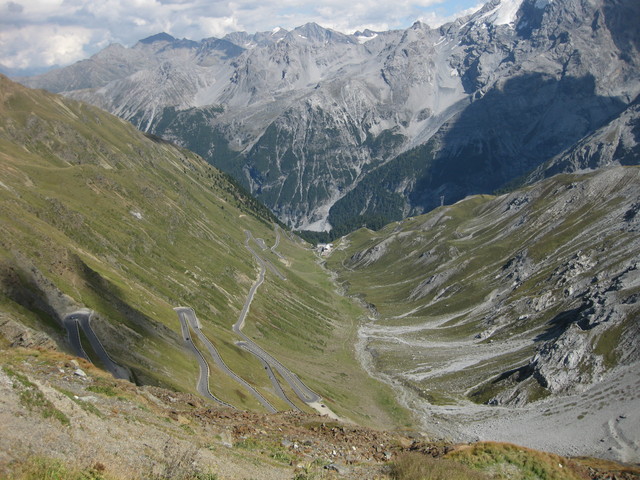
In signing up for this tour, I was at last fulfilling a dream to cycle in Europe. When I realized that I might have a chance to climb the legendary Stelvio Pass, I was thrilled. Now, I sincerely hoped that I had not burned out my legs on the Mortirolo loop.

It would be straightforward for us to approach the summit from Bormio; while I am sure that would be beautiful, the classic approach is from Prato allo Stelvio. The logistics would be a burden, but our host made it happen. He dispatched a few strong riders to tackle the climb yesterday, reducing the size of our group to fit into two vehicles laden with bicycles today.

We drove through Bormio and up to the summit of the Umbrail Pass. There, we bundled up and descended to the valley, passing through the town of Santa Maria (Switzerland) and looping back into Italy to start the famous climb from Prato allo Stelvio.

Ever the laggard going uphill, my plan was to descend as rapidly as possible to get ahead of the group before we started to ascend. We were warned to expect one unpaved section of road (a mile of packed gravel) on the way down. I was especially cautious there; one rider caught and passed me, but nonetheless I was the first to reach the valley. [Not having seen me descend until now, my fellow riders were surprised. "You were en pointe, the whole way down!" Nice way to put it. I smiled.]

At the border, the Italians waved us through, and I booked it all the way to Prato—where I promptly headed in the wrong direction. Having stopped for a bio break, I was separated from the rest of the pack and never saw the last sign toward the pass. (Evidently it was easy to miss, being somewhat obscured by a tree.) I approached a couple of guys in a parking lot, and they happily sent me in the right direction.

More than any other climb on this trip, I wanted to complete this one. I started going up; my legs felt surprisingly strong! I began to believe that I could do it. I have certainly done more climbing in a day than this would require, but not over such a short distance.

There are 48 switchbacks on the way to the top, and each turn is numbered. I rounded switchback number 48 after about 4 miles. Warmed by the effort, I had already peeled off my outer layer. Up to that point, the average grade was 6%; almost eleven miles remained, with an average grade of 7.9%.

The road is carefully maintained, smooth pavement swept clear of gravel and rocks. I quickly found a source of acceleration in taking the right line through each hairpin—every little bit of energy helps. About two thirds of the way up, the Berghotel Franzenshöhe serves the best apple strudel imaginable—my single portion filled a dinner-sized plate and sustained me over the rest of the climb.

Many cyclists passed me along the way, but as I drew nearer to the summit, it was my turn to pass. Endurance, I have. I am sure the diminishing concentration of oxygen slowed me further, but I reached 8,300 feet before I noticed. Painted marks on the road counted down the distance remaining: 6k ... 5k ... At hairpin number 1, I lingered in a state of awe.

There is quite a festival at the top of the Stelvio Pass: food, souvenirs, proud and exhausted cyclists, and plenty of tourists.


I traveled 38 miles by bike, climbing 6,040 feet along the way—virtually all of that climbing was packed into the last 15 miles. I am stunned to say this: It felt great! Which means, of course, that I should have ridden at a faster pace.

Next time ...

August 30, 2011

Bormio

On the menu for today was a climb to a lake. To make that feasible, our host arranged to shuttle riders forward in two groups. I landed in the group that would start cycling from our home base in Grosotto.

I was apprehensive about this ride; not only would it be my third consecutive day of cycling, I expected to pay for yesterday's excesses.

The group took off at a brisk pace, and of course, we started the gradual uphill journey almost immediately. Despite dropping down to my lowest gear, my legs were screaming and my hands were going numb (a new phenomenon, for me). By the time we reached our shuttle rendezvous point, we had climbed 880 feet over less than six miles.

I was not the only rider who was keen for a recovery day. When our host disgorged us near the base of the climb to the lake, all but two riders rebelled and opted for a simple ride back to our home base. We created our own adventure, finding our way to a café in the oldest section of Bormio. We visited a local bike shop, where we secured advice on following the bike path back to Grosotto. After sensing some uncertainty in our group about the route, I reconfirmed the plan with one of the shop's mechanics. A picture—in this case, a Google Map on my phone—was worth a thousand words (in any language). After yesterday, I was not so ready to cede navigational responsibility to anyone else.

The sky was threatening rain, but we made it back without incident and in time for lunch.

Our return route might seem downhill (on paper), yet we ended the day having ridden a respectable 27 miles and climbed 1,525 feet. Would my legs be fresh enough for tomorrow's queen stage?

August 29, 2011

Passo di Mortirolo

Heading out with the first riders was a lucky choice today, as we did not follow the traditional Giro d'Italia route to the summit of the Mortirolo. [Those who did, were humbled.] The climb from Grosio was not difficult; I paced myself, expecting the grade to worsen before I reached the top.

Approaching the summit, I was encouraged by the names still visible on the road (Basso, Nibali) and heralded by a cacophony of cowbells (on cows, of course). By the time I arrived, our group had split for lunch or to return to the start. Fortunately, I was able to hand my camera to a touring motorcyclist who paused for a break.

After lunch, my day went south—in both senses. Some miscommunication separated me from the group: I returned to the summit, hoping for some better photos, while the others thought I had gone ahead. I crossed paths with a few when I did start to descend, as they had been delayed by the Guardia di Finanza at the restaurant. [From what they gathered, the establishment was in trouble for not issuing receipts—and they had overcharged us. The tax men must have been expecting this, because they pounced as the last of our group were about to leave.]

I was not prepared to exercise my orienteering skills on this trip, and I failed to study the GPS track on my phone to understand where we were. Instead, I considered myself lucky to have synced up with the one fellow rider who spoke some Italian.

When we came to a fork in the road, we misplaced ourselves on the map. A sign pointed left, downhill, toward Doverio; the fork to the right had no sign and headed slightly uphill, which we did not expect. There was an arrow painted on the road, labeled "G F Pantani," pointing toward the uphill fork. It turns out that my reading was correct—Gran Fondo Pantani—and we should have followed that.

The key point, I now believe, is that the lack of a sign is a valuable clue: namely, that you are still on the main road and should keep following it.

We dropped down a steep set of switchbacks to Doverio, leading to an excursion along a highway (SS39) and adding an unwelcome climb up a minor pass. It also reinforced a surprising discovery about Italian motorists: They have tremendous respect for cyclists. Throughout the trip, it was rare for a vehicle to pass too closely. If there is not enough room to give us a wide berth, the driver waits. For their part, cyclists strive to travel in small bunches, leaving gaps that allow vehicles to leap-frog forward.

We passed through the town of Aprica and descended to Stazzona, at which point we found our way back to the intended route (more or less). I was oh-so-relieved when our home base, Grosotto, was in sight. After covering an unintended distance of 50 miles and climbing 6,600 feet, I was emotionally and physically spent.

And then, in an instant, I was restored: A passing motorcyclist, approaching in the opposite direction, waved and blew me a kiss! Grazie, signore; you made my day.

August 28, 2011

Eita

As we rolled northeast out of Grosotto, my eyes were immediately drawn to a small town on the hillside above us. While the valley and surrounding slopes were still deep in shadow, the rays of the sun fell on that cluster of buildings like a spotlight. Naturally, that is why they were built there.

Soon, we were passing through that very town—having entered neighboring Grosio, we hung a left and immediately started climbing.

As the road snaked ever upward, through fields and hamlets, I began to wonder about ... food. We were heading for the town of Eita, and I had no clue how far we would ride before we reached it. I regretted not bringing along a PowerBar. Just then, I rounded a bend into Fusino, and lo—the rest of our group had already invaded the café, and we soon found ourselves sharing a pie-sized chocolate tart.

One of my friends emerged from the toiletta. "Good luck with that," she said, as I stared down at the porcelain fixture in the floor. There is book knowledge, and there is empirical knowledge. [N.B. see Going Abroad].

Much relieved and refueled, I happily resumed our climb. Cowbells (attached to actual cows) greeted us at the summit, along with a splendid source of water. Our group split up, with some of us venturing a bit farther down the road. In this, we were well-rewarded.

We enjoyed an unforgettable lunch at Baita Franzini, where the experience was more like sharing a family meal than dining at a restaurant. Potatoes (boiled, then fried), stew (with local mushrooms), polenta, game (wild mountain goat), cheese, apple fritters, fresh fruit. Homemade wine shared in a 100-year old communal wooden bowl. Conversation ranged from Hurricane Irene (they offered to let us watch coverage on TV), to politics (Berlusconi), to cycling (of course). On Pantani: "God gave him a big heart and big lungs, but no brain!"

My first day of cycling in Italy. Beautiful route, 24 miles, 3,695 feet of climbing. Everything I had hoped for, and more.

August 27, 2011

Grosotto

My first few days in Italy were the appetizer; now it was time for the main course.

Returning the rental car was the most angst-inducing bit of driving yet. The garage was jammed, the spaces were tight, and cars were left in the driving lane. In true Italian style, someone flipped my passenger-side mirror back so I could squeeze through an opening that looked impossible. After driving 515 km without incident, was I destined to scrape the vehicle in the last 10 meters?

Next, I hauled myself and my baggage (remember that bicycle?) out to the bus that would take me to Bologna Centrale. One of the nuances of Italian train travel is the requirement to validate your ticket before boarding the train. Without prior research, this fine point would have escaped me. The high-speed train arrived in Milan in less than an hour. Needless to say, I collected some data: we averaged about 141 mph, with a top speed in excess of 162 mph.

At Milano Centrale, the ticket validating machine next to my train was non-functional. An Italian standing nearby launched into some lengthy exposition and did not stop even when I offered Non parlo l'italiano. I followed the lead of a fellow passenger and used the machine at an adjacent track.

The train ride to Tirano was neither high-speed, nor express. And that was just fine, as there was much to see along the way.

My final destination was the tiny, charming town of Grosotto. No longer a solo traveler, I would join our group for the start of our cycling adventures in the Italian Alps. We were staying at a "bike hotel," which caters to the needs of cyclists.

The Pika Packworks bag lived up to its reputation: lightweight enough to carry around, sufficient protection that the bicycle arrived unscathed. Reassembly went quickly and smoothly.

At last, ready to ride!

August 26, 2011

Bologna

Driving in Italian cities is a tricky proposition. Streets are narrow, zones can be restricted, and the locals seemingly engage in creative driving as a sport. The hotel advised parking near the train station; I researched garages in the vicinity and used the navigation function on my now-enabled cell phone to home in on my destination.

Bologna Centrale is a major hub, and the station was bustling. There were a couple of unsavory-looking young men loitering about, but they were outnumbered by officers in uniform. It was straightforward to buy a ticket from the automated machine and bypass the line at the ticket counter. After scouting the platforms, I started to believe that I could board the right train tomorrow.

I stepped out of the station just as an open-air tour bus pulled up. Brilliant! Plug in the earphones and tune the channel to your native language. The tour oriented me to the city and its sights; by the time it was done, I had enough confidence to explore it on foot. Most businesses close for a few hours at mid-day; I enjoyed a sandwich and cooled down with a new discovery, granita.

Bologna is not a top destination for foreign tourists. I knew I had blended well when some young Communists tried to hand me their leaflets.

There are some 23 miles of porticos throughout the city; back in the day, they were required on all buildings. They knew what they were doing—today they provided welcome relief from the hot summer sun. I learned that Bologna is the birthplace of Nobel prize winner Marconi (wireless telegraphy), and home to the oldest (still operating) university in Europe (dating back to the 11th century). I was startled to realize that I had passed through a section of the train station that was the site of a fatal bombing in 1980.

Next on my agenda was Post Italiane. The drill at the main post office would be familiar to anyone who has visited the California DMV: determine the right category for the service you need and take a number. I presented the clerk with three identical postcards addressed to the USA. He carefully weighed each and every one of them (!) and affixed the requisite postage.

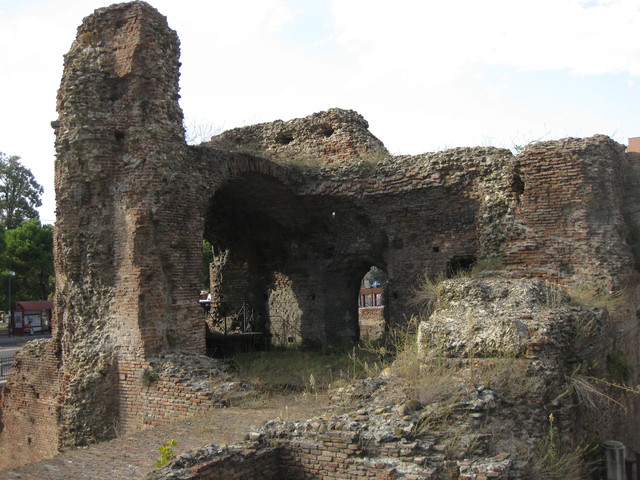
How do the Bolognese regard their city, I wonder? With its mixture of old and new, do the antiquities become a nuisance? Crumbling medieval walls, a leaning tower, monuments, fountains. Daily life flows around all of it, with hardly a second glance.