July 28, 2019

Kunsthaus Zürich

If the weather had cooperated, I would have headed back to the Alps—but alas, the forecast showed nothing but rain.

The common wisdom I've heard is that “Switzerland is closed on Sundays;” but evidently that's an exaggeration. Shops are closed, yes; restaurants (and museums!) are open.

I spent most of the day at the Kunsthaus Zürich, which seemed (to me) to be a nicely curated collection of works by well-known artists (Dali, Matisse, Monet, Picasso, Van Gogh).

This painting stopped me in my tracks, and I wanted to know more.

Otto Baumberger: Mass (1936)
The accompanying text was in German. I turned to Google Translate for help, and what I got was lyrical:
In his picture, Baumberger shows unemployed people during the Geneva unrest of 1932. In front of the cold row of windows of an anonymous façade, he places people who all look the viewer in the eye. They are mostly men, but in the foreground, in bright red, stands a woman, beside her a boy. Distress speaks from these faces, deprivation justified hopelessness. The title of the picture makes it clear that it is not about individuals, but about the mass, the wall of distress that they form together. Following a Käthe Kollwitz, Baumberger wants to make his ears heard here with his art. In the exhibition, the work stands for the socio-critical impetus that was important to many artists of the time.
A haunting image that, sadly, speaks to the world of today as well as it captures the world of its time.

There were many pieces throughout the museum by Giacometti which I didn't really like—with the exception of this painting, which was in a very different style than most of his work.

Augusto Giacometti: Contemplation (1907)

There were surprises in store, works by famous artists that were unfamiliar to me—and so different from familiar works that I would not have guessed at their creators. From a series of bronzes by Matisse,

Henri Matisse: The Back I-IV (1909-1930)

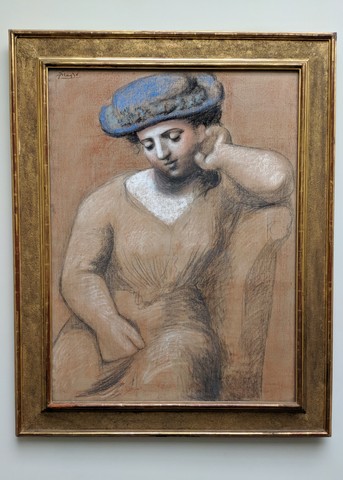
to a soft portrait by Picasso.

Pablo Picasso: Seated Woman with Hat (1921)

I never expected to see a piece painted by a girl (!) in the 17th century, but here was a self-portrait by an abundantly talented Anna Waser.

Anna Waser: Self-Portrait at the Age of Twelve As She Paints the Portrait of Her Teacher Johannes Sulzer (1691)

People-watching led to my favorite moment of the day. There were many families spending an afternoon in the galleries. I smiled as I watched these moms talking to their children about a particular painting; the young boy got so excited that he ran to get a closer look.

I have not found children to be a common sight in museums back home, unless they've been dragged there on an educational class trip.

And home is where I soon will be.

Auf Wiedersehen. Until we meet again.

July 27, 2019

Zürich, Take Two

One tip for traveling overseas with a bike is to buffer the trip with a day or two on both ends. From Burgdorf I headed back to Zürich, where the airport would be a short hop away.

A hunch and a little investigation paid off: When my train arrived, I headed straight for the “Left Luggage” office. For a small fee, I checked my bike bag. Not only did I not have to haul it back and forth to the hotel, they would transport it to the airport—where I would claim it a short walk from the airline's check-in counters. [I could get used to this ...]

After settling into my hotel on Saturday, I went for walk (uphill, of course).

This was fresh territory for me, having climbed above the city on the opposite side of the lake on a previous visit.

The higher I rose, the more it looked like the countryside.

 The afternoon light was dramatic, with a storm moving in.

I remembered to bring my umbrella. Steam rose from the pavement after some showers—something I haven't experienced for many years, as the rainy season in California is winter.

If you take a close look at how steeply the street drops off in my photo, you can see why I was happy not to be cycling here. I saw a sign marking a 22% grade on one hill, but I'd bet this street is steeper.

People do cycle here, however; and the infrastructure is done so well. In the photo above, we can see that the placement for bikes is separately allocated for cyclists turning left and for those traveling straight; and the “stop” line for vehicles is placed behind the bicycle markings. That way the cyclists are fully visible, and not expected to squeeze into the lane-width with a motor vehicle.

Back in town, I found a nice view of the Grossmünster towers as I strolled along the Linmat after dinner. One more full day before I head home ...